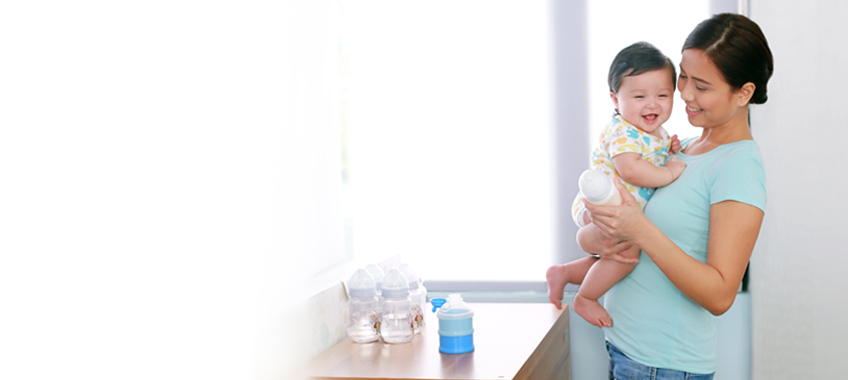
Maybe your maternity leave is over, or your baby is less interested in drinking milk now that they have started eating solid food. Whatever the reason, transitioning from breastfeeding to bottle feeding is not easy for any mother.
More than just mealtime, breastfeeding is also a special bonding moment between a mother and her baby. However, there comes a time when you may need to transition your baby’s feeding routine from breastfeeding to the bottle. While it can be challenging, taking the process one step at a time can make the transition easier for both you and your baby.
5 Tips for Transitioning from Breastfeeding to Bottle Feeding
1. Check Your Baby’s Readiness
The best sign to see if your baby is ready for bottle feeding is to let your baby decide.
At around 6 months of age, babies are usually well into eating solid food. This can be a good time to slowly introduce a bottle since they are beginning to get nutrition from other food sources and may nurse less often.
If you’re not yet ready to introduce your baby to solid food, take a look at how to ease them into it here.
2. Pick the Perfect Time
You cannot switch your baby’s feeding method from breastfeeding to bottle feeding overnight. It has to be done gradually.
Choose a time of day when your baby is usually relaxed and not overly hungry. Avoid offering the bottle during the first morning feed or the last feeding before bedtime, as these are often the times when babies are most attached to breastfeeding. Instead, try introducing the bottle during the afternoon while your baby is calm or engaged in play.
3. Let Someone Else Offer the Bottle
Babies tend to associate feeding with their mother’s breast. This is why it’s hard to convince them to drink from the bottle when the mother’s breasts are nearby.
Ask for help from either your husband or someone else with you to feed them using the bottle. Be sure to stay in another room while they do so that the baby does not see you. That way, your baby can keep their special bond of breastfeeding with you.
4. Find the Right Bottle and Nipple
Your baby may not accept the first feeding bottle you offer, so finding the right one often involves some trial and error.
Choose a bottle nipple with an appropriate flow. Holes that are too large may cause sputtering or gagging, while holes that are too small may make feeding frustrating.
It also helps to choose a nipple that is similar in shape and material to your baby’s pacifier. If they use a latex pacifier, consider using a latex bottle nipple as well. You can even rub a small amount of breast milk on the bottle nipple to help your baby become more familiar with it.
5. Ease Breast Engorgement
Some mothers stop breastfeeding their children regularly once they have successfully transitioned to bottle-feeding. In case you want to stop breastfeeding, your breasts may become painful because it takes a while for them to stop producing milk. You can try these steps to ease the pain:
- Apply a cold compress. Applying a cold, damp cloth reduces the pain. Surprisingly, chilled cabbage leaves work best for this situation too, as they take the shape of your breasts.
- Empty some milk. Pump some milk out of your breasts and refrigerate the breast milk to bottle-feed your baby at a later time. This removes some of the pain. Be careful not to empty them, however, as your brain might think that it needs to produce more.
- Leave your breasts alone. Be sure not to touch them too much. Massaging them sends a signal to your brain to produce more milk.
Be Patient During the Transition
Transitioning from breastfeeding to bottle feeding is not something that can be done overnight. It’s a slow process that involves a lot of patience for the mother. This is why transitioning your baby takes a lot of effort and time from all members of the family. But once your baby has successfully transitioned, it will all be worth it.
With consistency, encouragement, and support from your family, your baby will eventually adapt to their new feeding routine while continuing to grow healthy and strong.
Sources:
http://www.webmd.com/parenting/baby/features/weaningfrombreast
http://www.whattoexpect.com/firstyear/week47/weaning.aspx
http://www.babycenter.com/0_introducing-your-breastfed-baby-to-the-bottle-or-cup_473.bc